
Holding up the bench
Retaining Wall Earthwork in Salt Lake City, UT
The digging, drainage and backfill that decide whether a wall stands for decades.
- Free estimates at your property
- Itemized written quotes
- Blue Stakes locate before every dig
Walls Fail From Behind
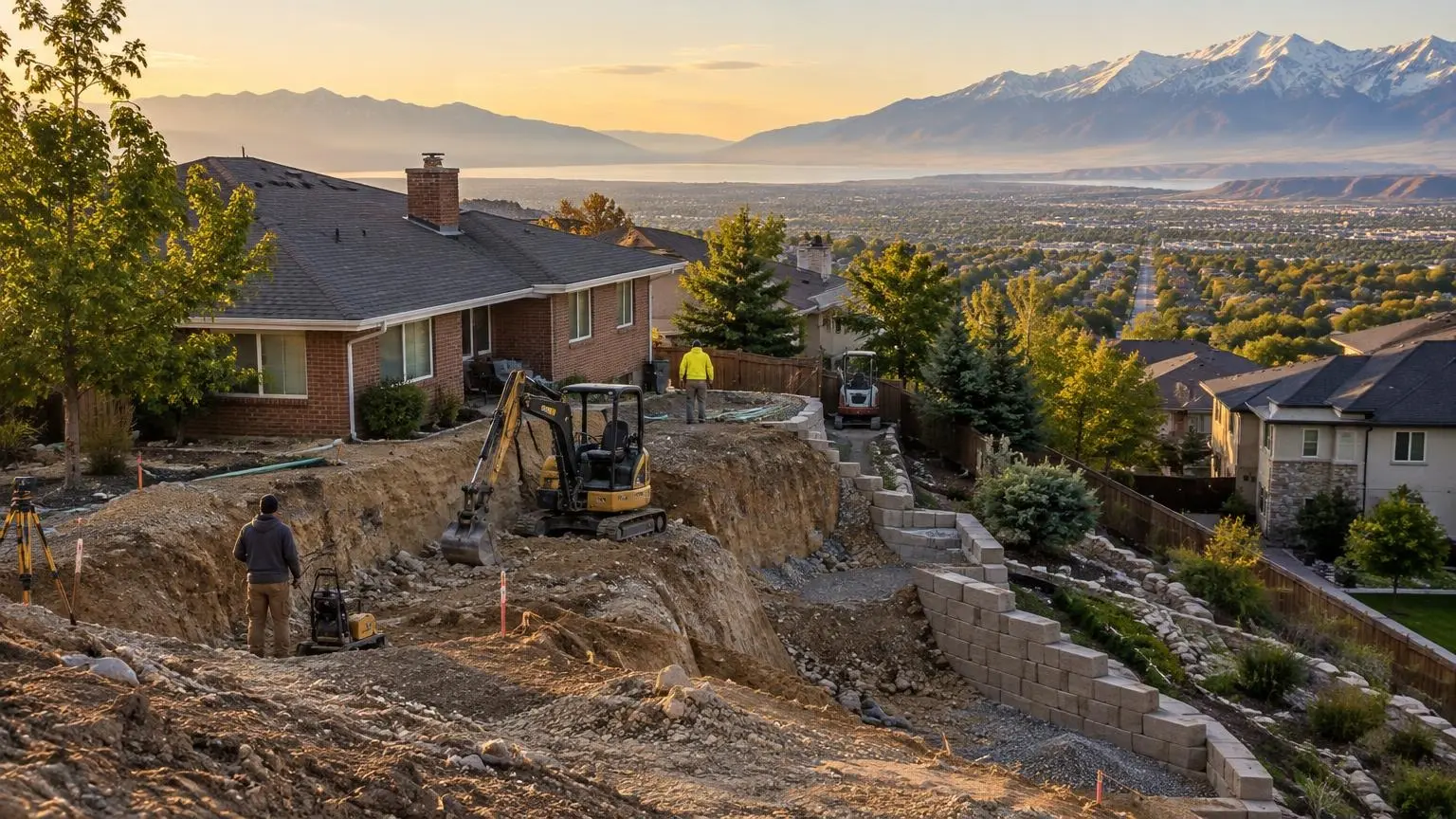
Retaining wall earthwork is the excavation, base preparation, drainage and backfill behind a retaining wall. Salt Lake City's neighborhoods climb onto the old Lake Bonneville shoreline benches, from the Avenues to the East Bench and the foothills of Draper and Bountiful, so sloped yards and walls are everywhere. Most wall failures come from what is behind and under the wall: poor drainage, uncompacted fill, or a footing that was not deep enough.
Water pressure is the enemy
Clay-rich lake soils hold water. When saturated soil pushes on a wall, the pressure can be many times what the wall was built for. We place free-draining stone behind the wall, a perforated drain at the base with an outlet, and fabric to keep fines out of the stone.
Height and engineering
HomeGuide notes that walls 4 feet or taller usually need a structural engineer's design and that most cities require permits for walls over 3 to 4 feet. Walls holding up a driveway, a house or a steep slope above often need engineering even when shorter. We build the earthwork to the design and tell you when we think one is needed.
Cutting into a slope safely
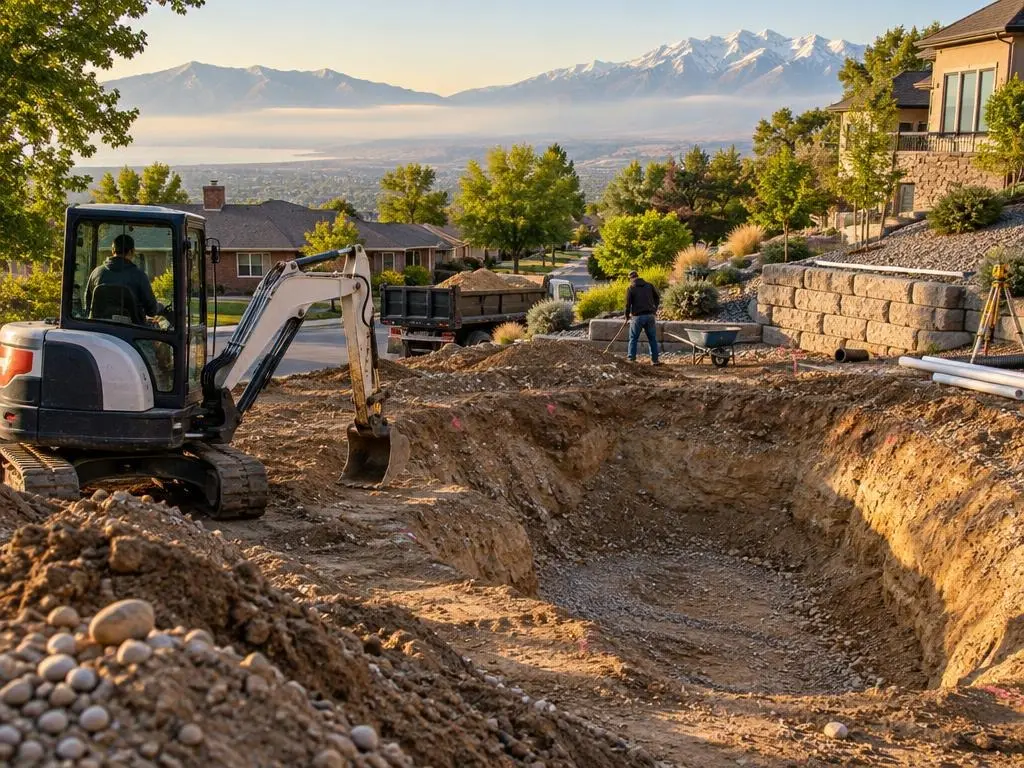
Building a wall usually means cutting into the hillside first, which leaves a temporary steep face. We keep those cuts short-lived, avoid undercutting neighbors' yards, and plan the work so the wall goes up soon after the cut.
Replacing failed walls
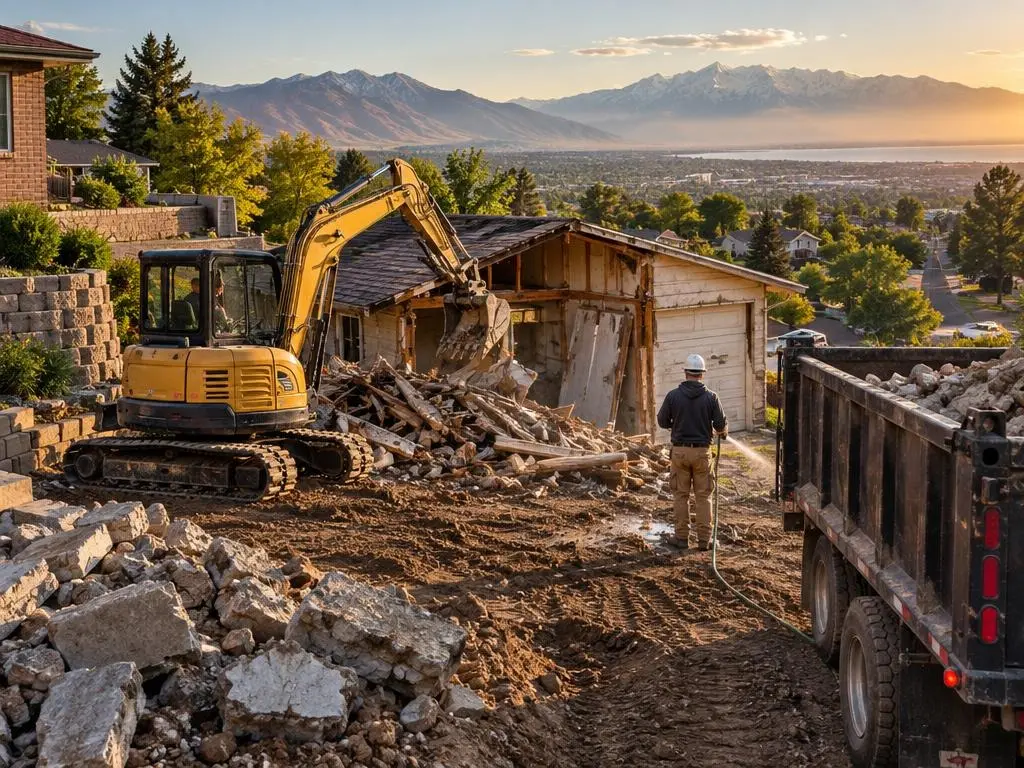
Leaning timber walls and bulging block walls are common in older neighborhoods. Replacement starts with demolition, which HomeGuide puts at $15 to $30 per linear foot, then excavating to undisturbed soil for the new base.
Typical wall costs
HomeGuide lists block walls at $15 to $40 per square foot of face, poured concrete at $20 to $45 and natural stone at $20 to $95, with a 50-foot, 4-foot-tall wall at $7,000 to $13,000. Sloped yards can add 50 percent or more.
Neighbors above and below
Walls often sit near property lines. Before cutting, we confirm the line, look at the neighbor's slope and structures, and plan the cut so it does not undermine their yard. Soil from the cut is often reused as backfill behind the new wall when it is suitable, which cuts hauling costs.
Timing
Backfill and compaction behind a wall go best in dry weather. Saturated clay cannot be compacted properly, so major wall work is scheduled outside spring melt where possible.
What This Covers
Everything below and behind the visible wall.
Slope cuts
Excavation into the hillside to make room for the wall and its base.
Leveling pads and footings
Compacted gravel pads or footing trenches for concrete walls.
Drain stone and pipe
Free-draining stone, fabric and a perforated drain with an outlet.
Geogrid backfill
Compacted backfill placed in lifts with reinforcement where the design calls for it.
Old wall removal
Failed timber, block or concrete walls removed and hauled.
Terracing
Several shorter walls instead of one tall one, where the yard allows.
Typical Retaining Wall Earthwork Costs
| Item | Typical cost |
|---|---|
| Block wall, per sq ft of face (HomeGuide) | $15 to $40 |
| Poured concrete wall, per sq ft (HomeGuide) | $20 to $45 |
| 50 ft long, 4 ft tall wall (HomeGuide) | $7,000 to $13,000 |
| Old wall demolition (HomeGuide) | $15 to $30 per linear foot |
| Structural engineering (HomeGuide) | $500 to $2,000+ |
| Hillside digs (HomeAdvisor) | $1,000 to $5,000 |
HomeBlue figures are for Salt Lake City; other rows are national published ranges. Depth, access, groundwater, hauling and permits change the total. The written estimate for your job is the price.
How It Works
1. Assess the slope
We look at height, soil, water and what the wall will hold up.
2. Design
Your wall builder or engineer sets the design; we price the earthwork to it.
3. Cut and base
Slope cut, base or footing prepared on firm soil.
4. Drain and backfill
Stone, pipe and fabric placed; backfill compacted in lifts as the wall rises.
Retaining Wall Earthwork Questions
Why is my retaining wall leaning?
Usually water pressure behind it, too little drainage stone, or a weak base. Rebuilding with proper drainage fixes the cause.
Do I need a permit for a retaining wall?
Many cities require one for walls over 3 to 4 feet or walls that carry extra load. We check with your city.
Do you build the wall itself?
We handle the excavation, base, drainage and backfill and work alongside the wall builder or mason.
Can two short walls replace one tall one?
Often. Terracing spreads the load and can avoid an engineered wall, if the yard has room.
Retaining Wall Earthwork Service Areas
- Excavation Contractors in Salt Lake City, UT
- Excavation Contractors in South Salt Lake, UT
- Excavation Contractors in Millcreek, UT
- Excavation Contractors in Holladay, UT
- Excavation Contractors in Murray, UT
- Excavation Contractors in Cottonwood Heights, UT
- Excavation Contractors in Sandy, UT
- Excavation Contractors in Draper, UT
- Excavation Contractors in West Jordan, UT
- Excavation Contractors in South Jordan, UT
- Excavation Contractors in Riverton, UT
- Excavation Contractors in Herriman, UT
- Excavation Contractors in West Valley City, UT
- Excavation Contractors in Taylorsville, UT
- Excavation Contractors in Kearns, UT
- Excavation Contractors in Magna, UT
- Excavation Contractors in Midvale, UT
- Excavation Contractors in Bountiful, UT
- Excavation Contractors in Farmington, UT
- Excavation Contractors in Centerville, UT
- Excavation Contractors in Layton, UT
- Excavation Contractors in Lehi, UT
Get a Retaining Wall Earthwork Estimate
Free retaining wall earthwork estimates.